
The Hunger
Tending to the thing that causes us to eat ourselves. Knowing what's behind the mask.

Liz Gilbert is one of my favorite writers. An excerpt of her upcoming memoir appeared in the Guardian this weekend, a book with a decidedly different tone that Eat, Pray, Love:
If this were a 12-step meeting in the recovery fellowship that I attend on a regular basis, and if I were speaking about my own addiction, this is how I would begin: “Hi, my name is Lizzy and I’m a sex and love addict.” If I wanted to get more specific about the matter, I might add: “I’m also a romantic obsessive, a fantasy and adrenaline addict, a world-class enabler, and a blackout codependent.”
My addiction manifests as a sincere yet deeply misguided belief that somebody outside of myself will miraculously be able to heal me on the inside – thereby making me feel safe, cherished and whole at last. I have spent my entire life searching for that magical person who will see me and save me.
As with many addictions, it can be fun at first, but then it quickly becomes hell. Because here’s how the story always ends up, whenever I fall into desire and obsession to this degree: as my addict brain becomes increasingly tolerant of these abnormally elevated levels of hormones, I will eventually need to score bigger and bigger hits of “reward” to experience the same high I felt at the beginning I felt at the beginning of the romantic encounter. I will do anything to get that release and relief again.
She continues with how she used money as a way to get love:
For codependents, fostering dependency in others makes us feel safe, valuable and in control. And pretty soon I was hurling cash at people exactly the way I used to hurl my body at them. I paid off the credit card bills and school loans of my family members and friends; I bought them clothes and jewelry and houses; I invested in their businesses; I supported their artistic projects; I paid for their weddings; I sent them on dream vacations, subsidized their therapy, financed their home renovations and covered tuition for their children. I paid the medical bills of strangers, and I bought cars for neighbours who were going through tough times. I invented endless work projects around my home in order to give jobs to various local craftspeople. I tithed to churches I did not even attend. (emphasis in original).
Her best friend Rayya received a diagnosis of terminal pancreatic cancer and she immediately realized that she was in love with her. She divorced her husband (the Brazilian she married in Eat Pray Love) to be with and take care of her in her final days. She lived that time in a maniacal high:
I began to really pour myself into Rayya – showering her not only with love and care but also with money and resources. I completely took over her life from a financial standpoint, not only paying for her medical expenses and her rent and her bucket-list experiences but also buying her things. So many things! Anything Rayya had ever wanted I insisted she must now have. Had she specifically asked me for these things? I cannot now remember. But I desired her. So I gave it all to her, and fuck the expense: I didn’t care if it bankrupted me.
Do you want a Range Rover? Here is your Range Rover.
Do you want a brand-new piano? Here is your brand-new piano.
Do you want a Rolex and Prada boots? Here are your Rolex and your Prada boots.
Here you go, my love – it is yours, it is yours, it is all yours!
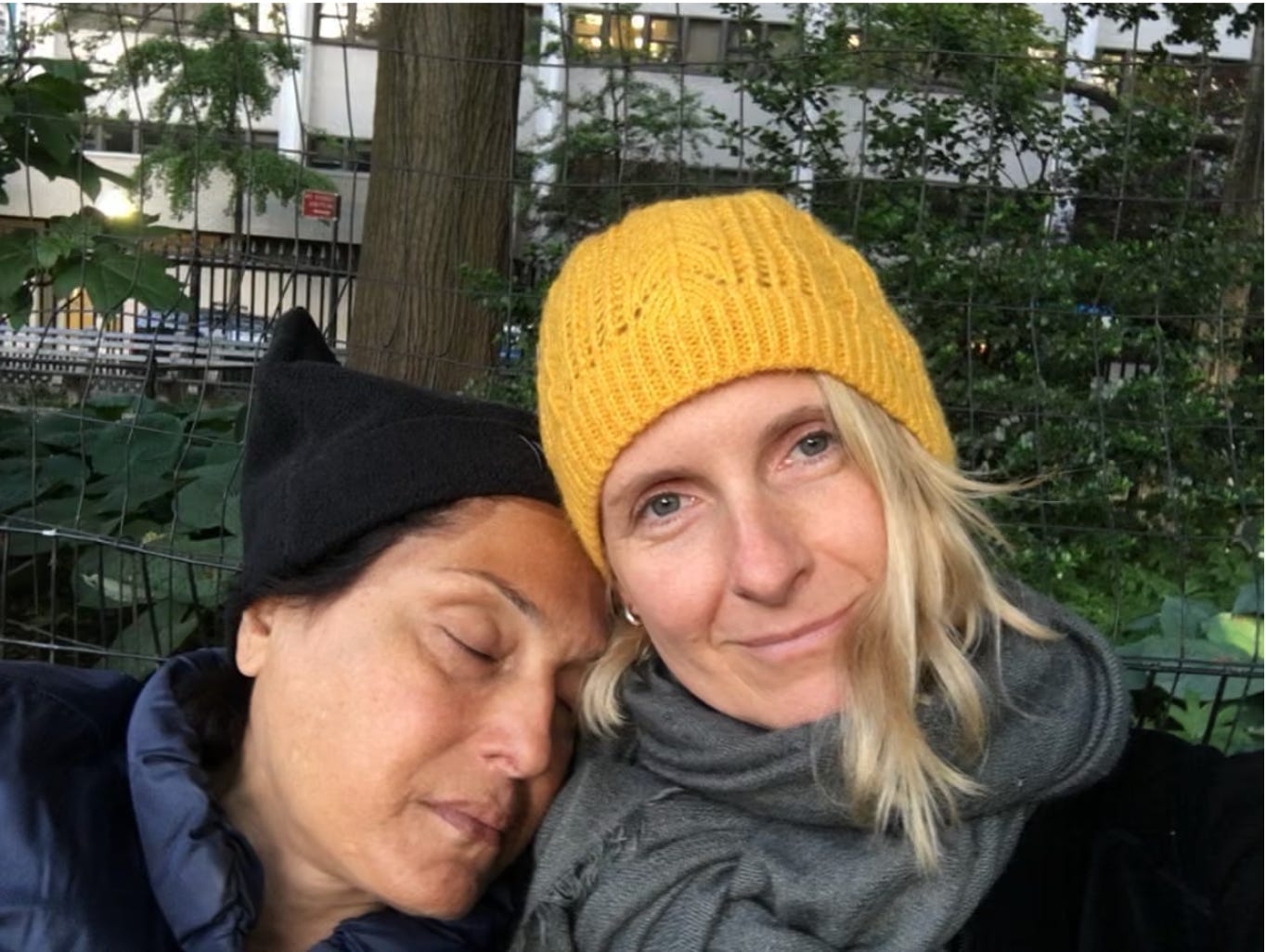
But being addicted means is that you need ever more to feel the same initial high. However, you never do get to the same high, and suddenly you need ever more just to feel OK. Gilbert hits what addicts call rock bottom when, after months of maniacal devotion, reaches the end of her rope, and attempts to murder Rayya. Failing that, she stumbles out onto the streets of New York and plans to commit suicide. There she hears the voice of God and calls to seek help. At the end of the essay (really worth reading),1 she writes that she lives alone and is five years sober.
The Hunger, the Fames
Gilbert’s essay reminds me of the Greek myth of Erysichthon. The Greek king decides to down a sacred poplar tree to build an extension to his house so he could hold bigger feasts. The goddess Demeter, taking form of a mortal woman, advises Erysichthon against cutting down the tree, warning him of her wrath. Instead of listening, Erysichthon drives her away by threatening to kill her with his axe.
Demeter takes revenge. She sends the Fames, the personification of insatiable hunger, to him. Now, no matter how much he eats, he cannot satisfy his hunger. He sells everything in his kingdom to buy food, including, eventually, his daughter. In the end, he cannibalizes himself, eating himself alive.2

This is our addiction to consumerism.3 We have persistent yet misguided belief that something, in this case, buying some “thing” or some experience, will fulfill us, make us feel safe, cherished, and whole. And it does! But the catch: only temporarily. Things on the Outside don’t solve things on the Inside. So we need ever more on the outside just to feel OK inside.
Our addiction to consumerism is really just a symptom of our addiction to our egoic individuality, our “selves.” The Buddhists talk about our hungry ghosts, the state of being reborn into a state of perpetual suffering due to intense greed, spite, or unfulfilled desires in a past life. These slaves to their addictions, compulsions, and additions, they have enormous, distended stomachs and tiny mouths, symbolizing their insatiable hunger and inability to satisfy their cravings, as what they try to consume turns to fire or poison.
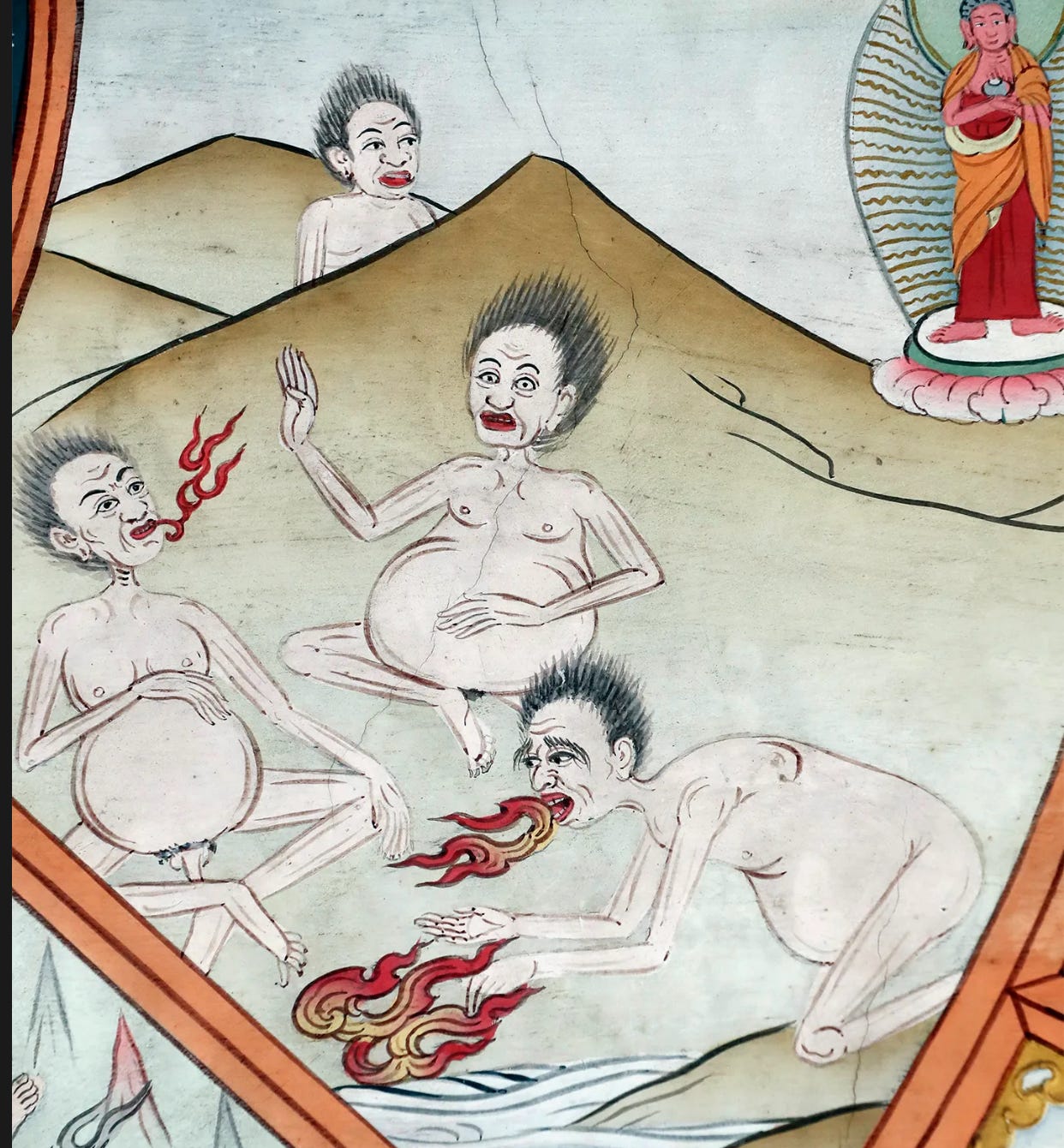
Our addiction to our selves insists that anything we want, we must now have. A tight, angry demand for fire and poison. Had we specifically asked for these things? We cannot now remember. But we do it because we think it sees us4 and it will save us.5 We consume (i.e. destroy) twice as much as we did 25 years ago, four times as much as we did 50 years ago. Instead of listening, we consume, i.e. destroy, nature to build our egos. More travel. Bigger homes. We’re consuming 5 times faster than the planet can replenish itself. Like King Erysichthon we destroy what is sacred to build extensions to our egos. What incredible poverty. As we do, we, like King Erysichthon, continue to get hungrier. Insatiably, urgently so (do you know anyone who wants less?). Incredibly, we continue to sell everything we have, our entire kingdom, to satisfy this hunger. The cost of consumerism includes the most active years of our lives.
The cost is enormous, but we don’t care if it is bankrupting us. We ignore the fact that we’re consuming our lives. We cannibalize our time to keep feeding the Hunger.
Voluntary simplicity
I always quote Lynne Twist and her Three Toxic Myths:
There is not enough (and I am not enough)
More is better (and I have to get mine first)
And that’s the way it is.
The only answer is voluntary simplicity. There is enough for everyone. And enoughness is an inside job. More is not better. We don’t have to be like this.
Accepting our inner not-enoughness is only way.
As I always preface, I’m not a Biblical scholar; I don’t even consider myself a Christian. So I’m not sure what Jesus means in the Beatitudes with “blessed are the poor in spirit,” but I translate it to do with the humility of seeing our brokenness, our persistent not-enoughness. Recognizing our powerlessness is the first step. Seeing our ego’s Hunger, and seeing our ego’s desire for the Fames, that desire for an Outside to solve our Insides. And realizing the desire of more of whatever is Outside is not the answer.
How much money would you spend if you knew you were Enough? How would you spend your life if you knew you were Enough? Voluntary simplicity is the practice of recognizing enoughness.
There’s a longer, interesting exploration here for where I am in my own life: when Liz Gilbert was giving all her money to supporting her family, friends, neighbors, community, and even strangers, wasn’t that a good thing? Wasn’t she being generous, practicing the selfless act of “seeing no stranger?” For me, at the first stage of my giving journey, the lesson here is that even participating in kenosis, the “self-emptying” mystics talk about, can still be another disguise of not-enoughness. Acting from a lack of self-love is something to be aware of for those of us whose core values include Service. As Liz points out, caring for others can be still be the ego self trying to feel safe, valuable, and in control. Even when we are trying to love we can still motivated by the Hunger.6 Are we giving out our enoughness, or our not-enoughness? By doing what feels good and authentic, are we actually just eating fire and poison? There’s some uncomfortable shit here.7 As Alan Watts says, the biggest taboo of all is against seeing what’s truly behind the mask.
You can never fully run away from what’s inside, although any addiction will pull you further away from it. Voluntary simplicity is the call to stop running, to slow down and embrace what you have been given. If you want to know the truth about yourself, you have to look inside and see what’s behind the mask.
The Light after the Darkness
I was born when all I once feared, I could love. — Rabia of Basra
Quakers also believe that there’s something else inside: a still, small voice telling you are enough. That you loved beyond cause and measure. It whispers: This is all Gift. All of it. So it has always been.
All of it. Even, impossibly, and necessarily, the “bad” stuff.
It is grace to know that. Voluntary simplicity is to savor grace, even dark grace, to find goodness, even in our not-enoughness. Maybe it takes hitting rock bottom, like Liz, holding those morphine tablets and sleeping pills in her hands on a cold day in New York. Sometimes the only way out is through. Maybe this addiction to Rayya was the only way for Liz to finally see her lifetime of codependency. The Light after the darkness after the light.8 Eating fire and poison until she realized she couldn’t anymore. For some, this is the way. It is only then surrender and acceptance, and then the long road back. As the psychologist Carl Rogers once said, “The curious paradox is that when I accept myself just as I am, then I can change.”
The freedom of flight, the wonder of wings.
Oh, the difficult path to accept myself just as I am. To see and care for my hungry not-enoughness, that tender old wound. All part of the Gift. To keep trying to feed the Hunger until we realize finally, one day, it doesn’t work. Surrender. Humility. Grace everywhere, all the time. As Catherine of Siena says, “all the way to heaven is heaven.”
Grace, lining the entire path to grace.
Reader Get-Together this Sunday 10am PST
Zoom meetup this weekend Sunday at 10am PST. Here’s the link. If you’re coming, come with the answers to (1) what’s been your favorite post? and (2) What’s a question or issue you want to talk about?
Finding the Great Work of Your Life in October and January
I wrote a few months ago that I wanted to do a course on the book The Great Work of Your Life by Stephen Cope. I’m rebooting Portland Underground Grad School in October, so I decided to pilot the course live in October. I plan on doing it online with my good friend Jon Marro in January (course listing to come after the pilot).
Interested in the course? Live in Portland in October, online in January.
Also worth reading, Eat Pray Love and the marketing self-empowerment and self-fulfillment moment. Notice the word “self.” The greatest addiction we have is to our “self.” https://www.theguardian.com/theguardian/2010/aug/14/eat-pray-love-julia-roberts
Closely related, the recent Demi Moore movie The Substance.
And for some of us, workism.
The job of the marketer
The lie of the marketer
Especially Enneagram 2s. OK, half-assed attempt at explaining Enneagram types (ie egos) try to feel safe, valuable and in control: 1s by being righteous and ethical. 2s by being giving and helpful. 3s by being successful and admired. 4s by being special and authentic. 5s by observing and withdrawing. 6s by being loyal and responsible. 7s by being free and avoidant. 8s by being confident in charge, 9s by being easy-going and avoiding conflict.
Shit that destroys any sense of my own self-superiority.
Liz Gilbert: “My friend Rob Bell talks about "the Light after the Darkness after the Light." There's a lightness that people have that is about innocence, naiveity. It's top 40 music, let's go to the beach. It's almost "lite." But it looks like exuberance and fun and good times.
And then after that, comes the darkness. Some people don't emerge out of that. Sometimes what doesn't kill you, fucks you up, doesn't make you stronger, it just leaves you a wreck and some people can't get through that and are a wreck and they are in that Darkness.
And then there are people who pass through that to the light on the other side of that darkness. And they are radiant with something like what it's like to be around Dan, where you can't accuse that of being laughter, giggling and enjoyment. That is somebody who has literally walked through fire. Because of that there's a resonance to the joy and the miracle that we're still here. You wanna know what the Dalai Lama and Archbishop Desmond Tutu do when they meet, because they're old friends apparently? They bump tummies a bunch of times and they just start giggling. These are two people who you can accuse of being frivolous or not understanding human suffering.
But they are the Light on the other side of the Darkness on the other side of the Light. And boy, when you're around somebody like that, do you feel it, do you feel the Grace... and the human suffering….
People in the light before the darkness have an innocence to them, but that innocence is also tinged with an entitlement. "It's supposed to be" this way. Only after you've been in the darkness do you realize the light isn't a given, it's a gift.
When you come to the end of yourself is where all the interesting stuff starts.”
Thank you for this gift. I’ve been thinking a lot about voluntary simplicity and enoughness in my own life. Timely wisdom, as always. ❤️
I really enjoyed your approach here. Thank you for the post.